Translate
What’s happening in Rainbow Schools?
Young scientists from Rainbow Schools to compete nationally
Six young scientists from Rainbow Schools who impressed the judges at the Sudbury Regional Science Fair on April 11th and 12th will represent our community at the Canada-Wide Science Fair in Edmonton from May 23 to 30, 2026. They will be among hundreds of young scientists showcasing their works of discovery and innovation at the national level.
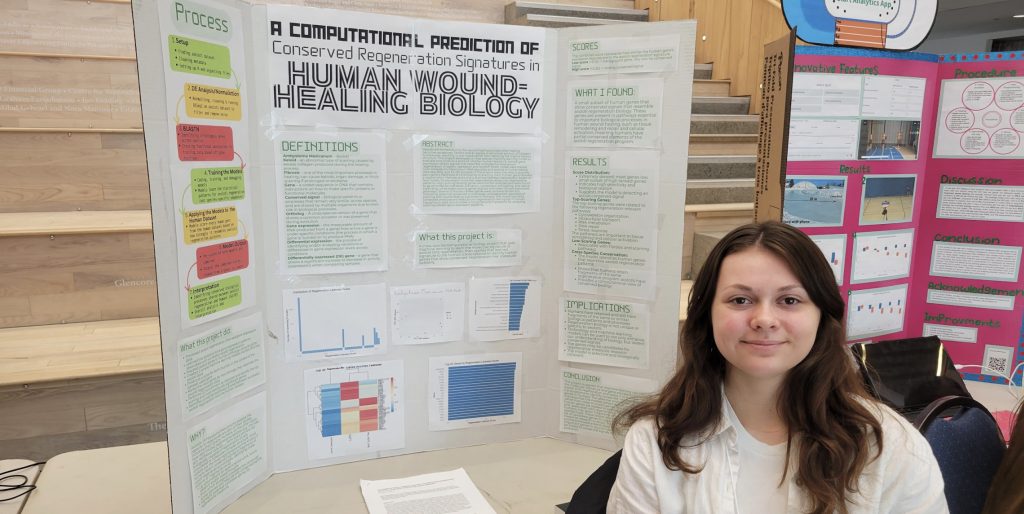
Ariana Demers, a Grade 10 student from Lockerby Composite School, captured top honours for her project “Conserved Regeneration Signatures in Human Wound Biology”. For her project, Ariana created machine learning models trained from axolotl RNA-seq regeneration data to identify which human genes show patterns similar to those involved in axolotl regeneration. Two models were created – logistic regression, which is a simple and interpretable method that looks for linear relationships in the data – and a random forest model, which is a more powerful model that uses decision trees to learn and apply data and capture complex biological patterns. The scores of the models were combined, creating an overall “regeneration-likeness” score for every gene in the input (human) dataset. The input dataset was a human keloid versus normal scarring RNA-seq dataset, in order to provide greater contrast between fibrotic and more “regeneration-like” genes, highlighting which genes show the strongest conserved signals/patterns and play the most vital roles in this context. Several of the top 10 highest scoring genes (most regeneration-like) were uncharacterized, meaning that there is very limited information currently known. This suggests that they may play more vital roles in healing biology or may be potential candidates for study in regenerative medicine. For her efforts, Ariana Demers garnered First Place, Intermediate Division, Computer Sciences; the Computer Science Award; and Best in Fair.
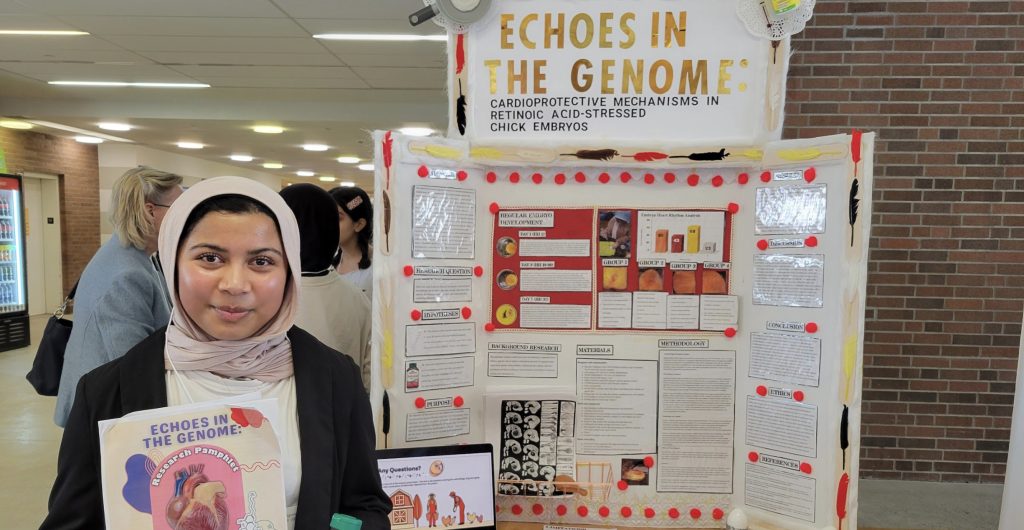
Farheen Shams, a Grade 10 student from Lockerby Composite School, earned a spot at the Canada-Wide Science Fair for her project “Echoes in the Genome: Identifying Cardioprotective Agents.” What if a simple vitamin could prevent heart defects before birth? This project was a novel application to use simpler substances to treat Congenital Heart Defects (CHDs), as traditional methods used to treat this disease were financially challenging. By modifying heart gene expressions using retinoic acid (Vitamin A) in chicken embryo models to simulate heart defects, this project also investigated whether folic acid (Vitamin B9) could serve as a cardioprotective agent. The results showed that retinoic acid interfered with normal heart formation, while folic acid offered partial protection. These findings highlight how everyday nutrients may play a powerful role in shaping early development and future health. Farheen Shams’s project “Echoes in the Genome: Identifying Cardioprotective Agents” earned First Place, Intermediate Division, Life Sciences; the Biology Award; and the Chemistry/Biochemistry Award.
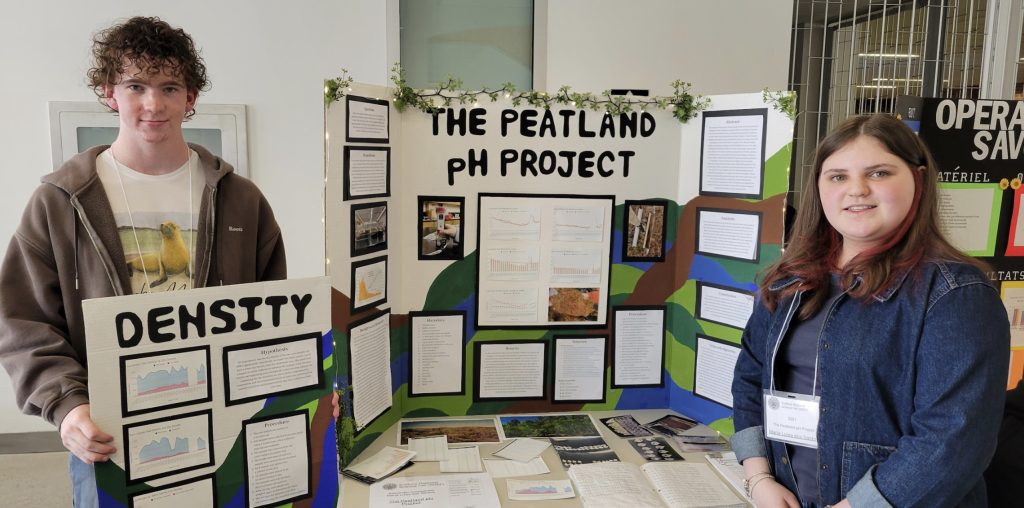
Alexander Crossgrove and Maria Luisa dos Santos, Grade 10 students from Lockerby Composite School, prepared “The Peatland pH Project”. Their project investigated how soil pH and density change over time using a peat core sample from a peatland at the Lake Laurentian Conservation Area as well as a peatland outside of Nairn Centre. The results showed a decrease in pH (higher acidity) at certain depths – likely caused by historical mining pollution. Deeper layers had higher pH levels representing pre-mining conditions. Density also varied with depth, providing additional evidence of changes in soil composition and environmental conditions over time. For “The Peatland pH Project”, Alexander Crossgrove and Maria Luisa dos Santos earned First Place, Intermediate Division, Physical Sciences; the Earth Sciences Award; the Modern Mining and Technology Sudbury Award; the Snolab Award – Intermediate; and the Community Changemaker Award.
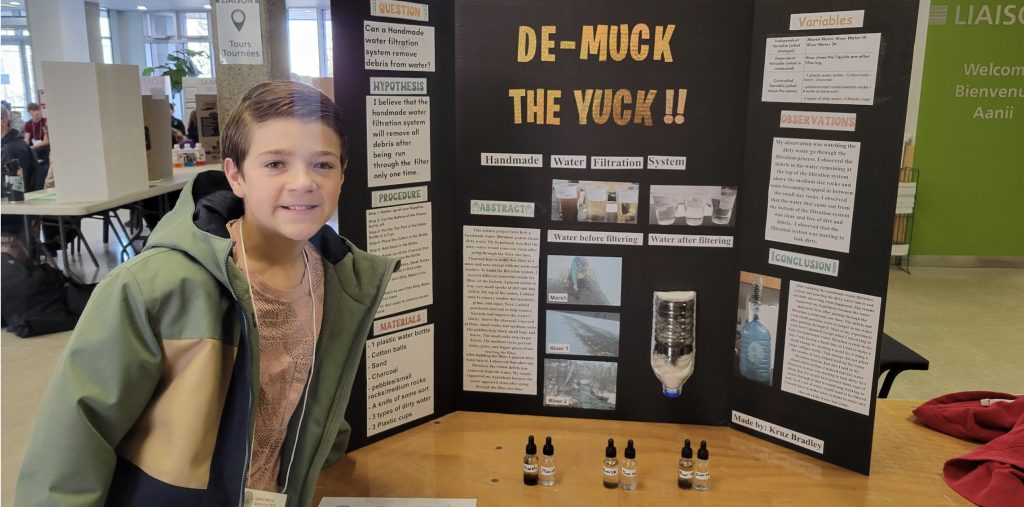
Kruz Bradley, a Grade 7 student from Northeastern Elementary School, impressed the judges with his project “De-Muck the Yuck” which tested how a handmade water filtration system could clean dirty water. To build the filtration system, Kruz layered different materials in a water bottle. At the bottom, he placed cotton to trap very small specs of dirt and tiny debris. Next, he added sand to remove smaller dirt particles, grime and algae. Then, he added powdered charcoal to filter smaller particles and improve the water’s clarity. Above the charcoal, he layered pebbles, small rocks and medium rocks – the pebbles helped to block small bugs and leaves, the small rocks stopped larger debris, and the medium rocks prevented sticks, grass and bigger pieces from entering the filter. Once ready, he poured dirty water into the water bottle. After only one filtration, the visible debris was removed from the water. The filtered water would then be ready to be boiled to kill remaining bacteria. Kruz’s project showed that a handmade filtration system can be used as a first step to remove debris from the dirty water to prepare it for boiling. This could be helpful in emergency situations where access to clean water might not be available. For his project “De-Muck the Yuck”, Kruz Bradley took home First Place, Junior Division, Engineering.
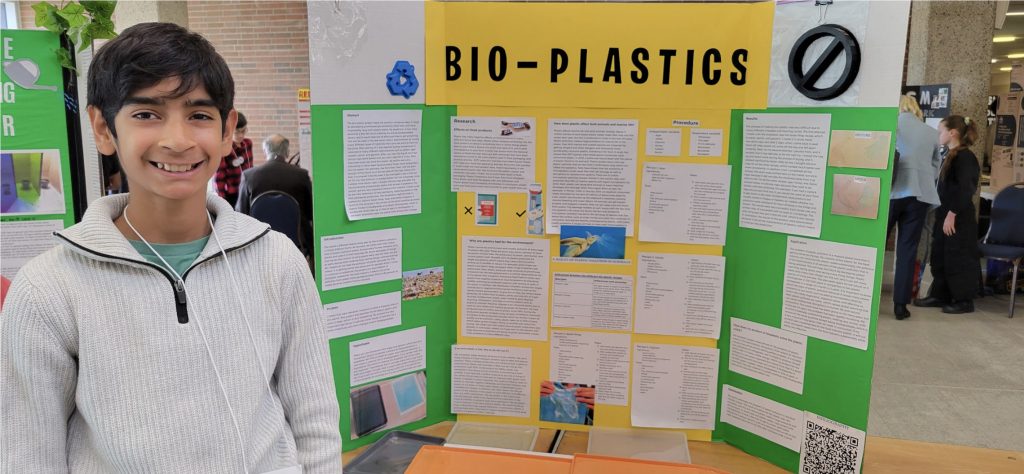
Ishan Shukla, a Grade 7 student from Lo-Ellen Park Secondary School – Intermediate earned a spot at the Canada-Wide Science Fair for his project “Bio-plastics”, which explored bioplastics as a solution to plastic waste produced by the food industry using biodegradable plastic alternatives. Bioplastics decrease greenhouse gas emissions, reduce the use of fossil fuels, and, most importantly, lower long-term plastic waste. Each year, over 400 million tons of plastic are produced for which the food industry is responsible for 33 per cent. This project consists of four different recipes for biodegradable plastics, each meant for a different use, and include ingredients agar powder, gelatin, pectin, glycerin and honey. In the beginning, there were many errors but the quality of the plastic improved over time. Some problems that arose during the experiment were thinness, unevenness, stickiness and fragility. After testing, the biodegrading rate is about 1 month to 2 years, compared to hundreds of years for traditional plastic. In conclusion, this product could be very effective if produced properly. For his project “Bio-plastics”, Ishan Shukla earned First Place, Junior Division, Life Sciences; the Biotechnology Award; the Environment Award and the Founding Members’ Award.
“These young scientists from Lo-Ellen Park Secondary School, Lockerby Composite School and Northeastern Elementary School earned the honour of showcasing their discoveries on the national stage,” said Director of Education Bruce Bourget. “We are certainly very proud of them for their outstanding achievement. We also thank our staff for their tremendous leadership and support of our students.”
Rainbow District School Board congratulates all Sudbury Regional Science Fair winners.
2026 SUDBURY REGIONAL SCIENCE FAIR WINNERS FROM RAINBOW SCHOOLS:
DIVISIONAL AWARDS
JUNIOR DIVISION – LIFE SCIENCES
First
Bio-plastics
Ishan Shukla
Lo-Ellen Park Secondary School – Intermediate
Second
Bot or not?
Sophia Kent
Lo-Ellen Park Secondary School – Intermediate
Third
Red 40 gets a Red Light
Isaac Le
Lo-Ellen Park Secondary School – Intermediate
Honourable Mention
Spray the mould away!
Sia Ma
Lo-Ellen Park Secondary School – Intermediate
INTERMEDIATE DIVISION – LIFE SCIENCES
First
Echoes in the genome: Identifying Cardioprotective Agents
Farheen Shams
Lockerby Composite School
Second
Can Disrupting Bacterial Communication Reduce Resistance?
Helia Dabiri Satri
Lockerby Composite School
Third
Microplastics Effect on Daphnia’s Heartrate
Dakshatha Lanka
Lockerby Composite School
Honourable Mention
scRNA-seq Network Discovery of Master Regulator Inhibitors
Felix Naghi
Lo-Ellen Park Secondary School
SENIOR DIVISION – LIFE SCIENCES
Second
Phage Inhibition on Bacterial Growth
Megan Martin
Lockerby Composite School
INTERMEDIATE DIVISION – PHYSICAL SCIENCES
First
The Peatland pH Project
Alexander Crossgrove and Maria Luisa dos Santos
Lockerby Composite School
JUNIOR DIVISION – ENGINEERING
First
De-Muck the Yuck
Kruz Bradley
Northeastern Elementary School
INTERMEDIATE DIVISION – ENGINEERING
First
Dry N’ Fly
Jax Perry
Lockerby Composite School
Third
BioCast Development
Guntas Jhand
Lockerby Composite School
INTERMEDIATE DIVISION – COMPUTER SCIENCES
First
Conserved Regeneration Signatures in Human Wound Biology
Ariana Demers
Lockerby Composite School
SPECIAL AWARDS
BEHAVIOURAL NEUROSCIENCE AWARD
Red 40 gets a Red Light
Isaac Le
Lo-Ellen Park Secondary School – Intermediate
and
Are We All Seeing the Same Colour
Fayona Shams and Hana Dabiri
MacLeod Public School
BIOLOGY AWARD
Echoes in the genome: Identifying Cardioprotective Agents
Farheen Shams
Lockerby Composite School
and
Phage Inhibition on Bacterial Growth
Megan Martin
Lockerby Composite School
BIOTECHNOLOGY AWARD
Bio-plastics
Ishan Shukla
Lo-Ellen Park Secondary School – Intermediate
CHEMISTRY AWARD
De-Stink the Rink!
Lachlan Kerr and Joshua Doiron
Lo-Ellen Park Secondary School – Intermediate
CHEMISTRY/BIOCHEMISTRY AWARD
Echoes in the genome: Identifying Cardioprotective Agents
Farheen Shams
Lockerby Composite School
COMMUNITY CHANGEMAKER AWARD
The Peatland pH Project
Alexander Crossgrove and Maria Luisa dos Santos
Lockerby Composite School
COMPUTER SCIENCE AWARD
Conserved Regeneration Signatures in Human Wound Biology
Ariana Demers
Lockerby Composite School
EARTH SCIENCES AWARD
The Peatland pH Project
Alexander Crossgrove and Maria Luisa dos Santos
Lockerby Composite School
ENERGY AWARD
The Zeer Pot
Fia Cormier and Megan Leclair
Lockerby Composite School
ENGINEERING AWARD
BioCast Development
Guntas Jhand
Lockerby Composite School
ENVIRONMENT AWARD
Bio-plastics
Ishan Shukla
Lo-Ellen Park Secondary School – Intermediate
ENVIRONMENTAL AWARD
Spray the mould away!
Sia Ma
Lo-Ellen Park Secondary School – Intermediate
FORENSIC SCIENCES AWARD
Bot or not?
Sophia Kent
Lo-Ellen Park Secondary School – Intermediate
FOUNDING MEMBERS’ AWARD
Bio-plastics
Ishan Shukla
Lo-Ellen Park Secondary School – Intermediate
INNOVATION AWARD
scRNA-seq Network Discovery of Master Regulator Inhibitors
Felix Naghi
Lo-Ellen Park Secondary School
MODERN MINING AND TECHNOLOGY SUDBURY AWARD
The Peatland pH Project
Alexander Crossgrove and Maria Luisa dos Santos
Lockerby Composite School
SCIENCE COMMUNICATION WRITING AWARD – ENGLISH
Phage Inhibition on Bacterial Growth
Megan Martin
Lockerby Composite School
SNOLAB AWARD – INTERMEDIATE
The Peatland pH Project
Alexander Crossgrove and Maria Luisa dos Santos
Lockerby Composite School
CANADA-WIDE SCIENCE FAIR PARTICIPANTS
Bio-plastics
Ishan Shukla
Lo-Ellen Park Secondary School – Intermediate
Conserved Regeneration Signatures in Human Wound Biology
Ariana Demers
Lockerby Composite School
De-Muck the Yuck
Kruz Bradley
Northeastern Elementary School
Echoes in the genome: Identifying Cardioprotective Agents
Farheen Shams
Lockerby Composite School
The Peatland pH Project
Alexander Crossgrove and Maria Luisa dos Santos
Lockerby Composite School
BEST IN FAIR
Conserved Regeneration Signatures in Human Wound Biology
Ariana Demers
Lockerby Composite School
-30-
Media Contact:
Nicole Charette, Senior Advisor,
Corporate Communications and Strategic Planning,
Rainbow District School Board, 705-674-3171, ext. 7217.