
 Translate
What’s happening in Rainbow Schools?
Students participate in Canada-Wide Science Fair in Lethbridge, Alberta
Four students from Rainbow Schools will participate in the Canada-Wide Science Fair in Lethbridge, Alberta from May 11 to 18, 2013. They will be among the top young scientists in Grades 7 to 12 chosen from approximately 25,000 competitors at 100 regional science and technology fairs from across the country.
“We congratulate all winners of the Sudbury Regional Science Fair,” said Rainbow District School Board Chair Doreen Dewar. “We wish our Canada-Wide Science Fair participants all the best at the national level.”
The following Rainbow students will showcase their projects at the 2013 Canada-Wide Science Fair – Helen Czapor, Grade 8, R. L. Beattie Public School; Connor Gran, Grade 10, Lo-Ellen Park Secondary School; John Laamanen, Grade 8, Algonquin Road Public School; and Connor MacLean, Grade 8, Algonquin Road Public School. Both Helen Czapor and John Laamanen captured top honours at the Canada-Wide Science Fair last year.
2013 CANADA-WIDE SCIENCE FAIR PARTICIPANTS
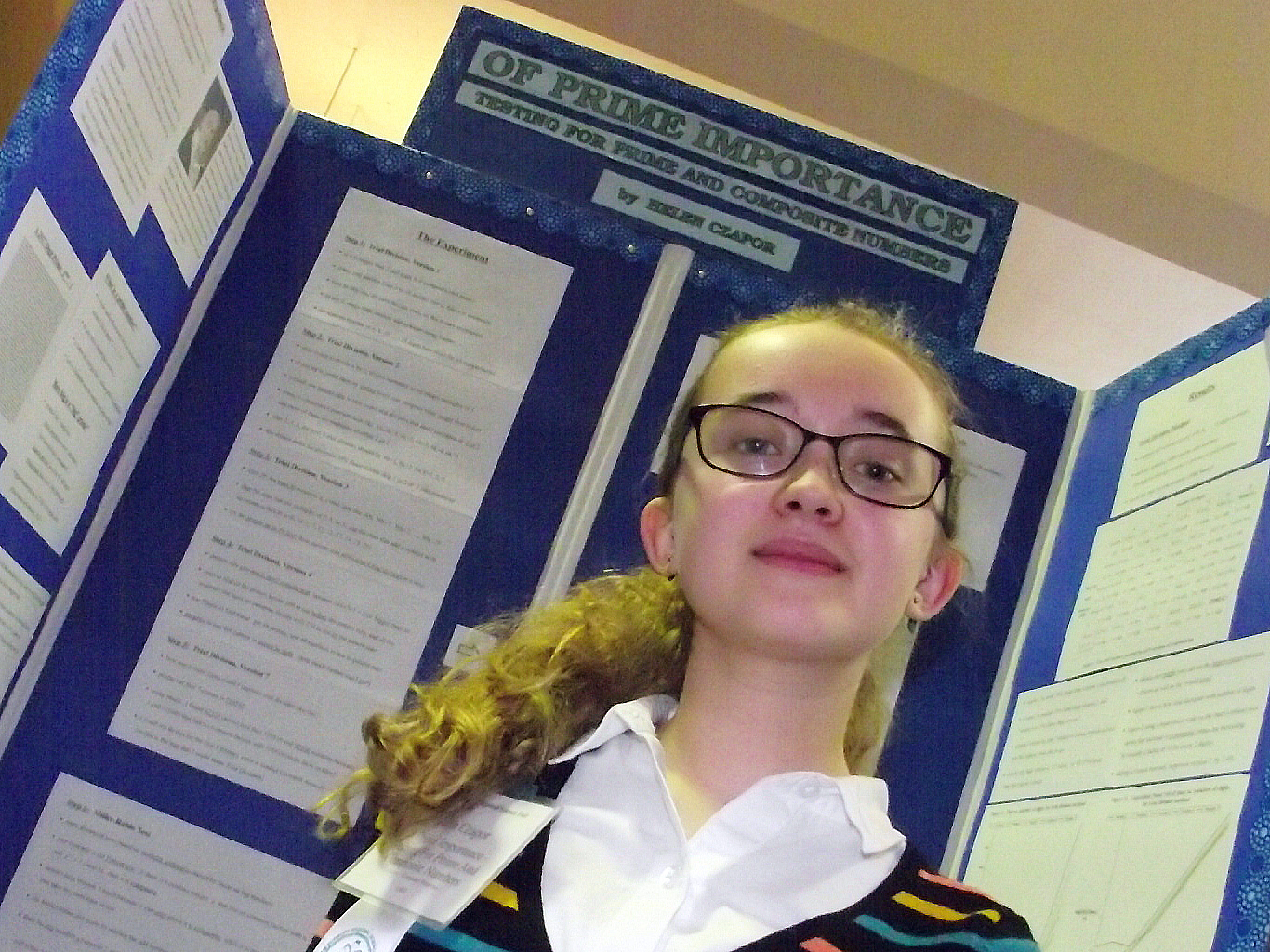 Of Prime Importance – Testing for Prime and Composite Numbers
Helen Czapor – Grade 8
R. L. Beattie Public School
Helen Czapor studied two different methods of testing numbers for primality. Trial division is a simple method that tests a number by searching for its smallest factor through divisions by smaller numbers. The Miller-Rabin method is called probabilistic since it can only say a number is prime to a degree of certainty. Her hypothesis was that she could improve trial division, but not by enough to be able to test gigantic primes. For these, she needed Miller-Rabin. She first tried to improve the speed of trial division by reducing the number of divisions used. She started by writing a computer program to do trial division in Maple. She then tried to improve it by reducing unnecessary divisions. Although this sounds easy, she found that it must be done correctly in order to actually speed things up, and that she could only improve the method by a factor of 3 before needing more computer memory. She also found that the time taken for trial division grows exponentially with the size of the number, so prime numbers over 50 digits could never be tested. By comparison, Miller-Rabin is fairly fast even for gigantic primes.
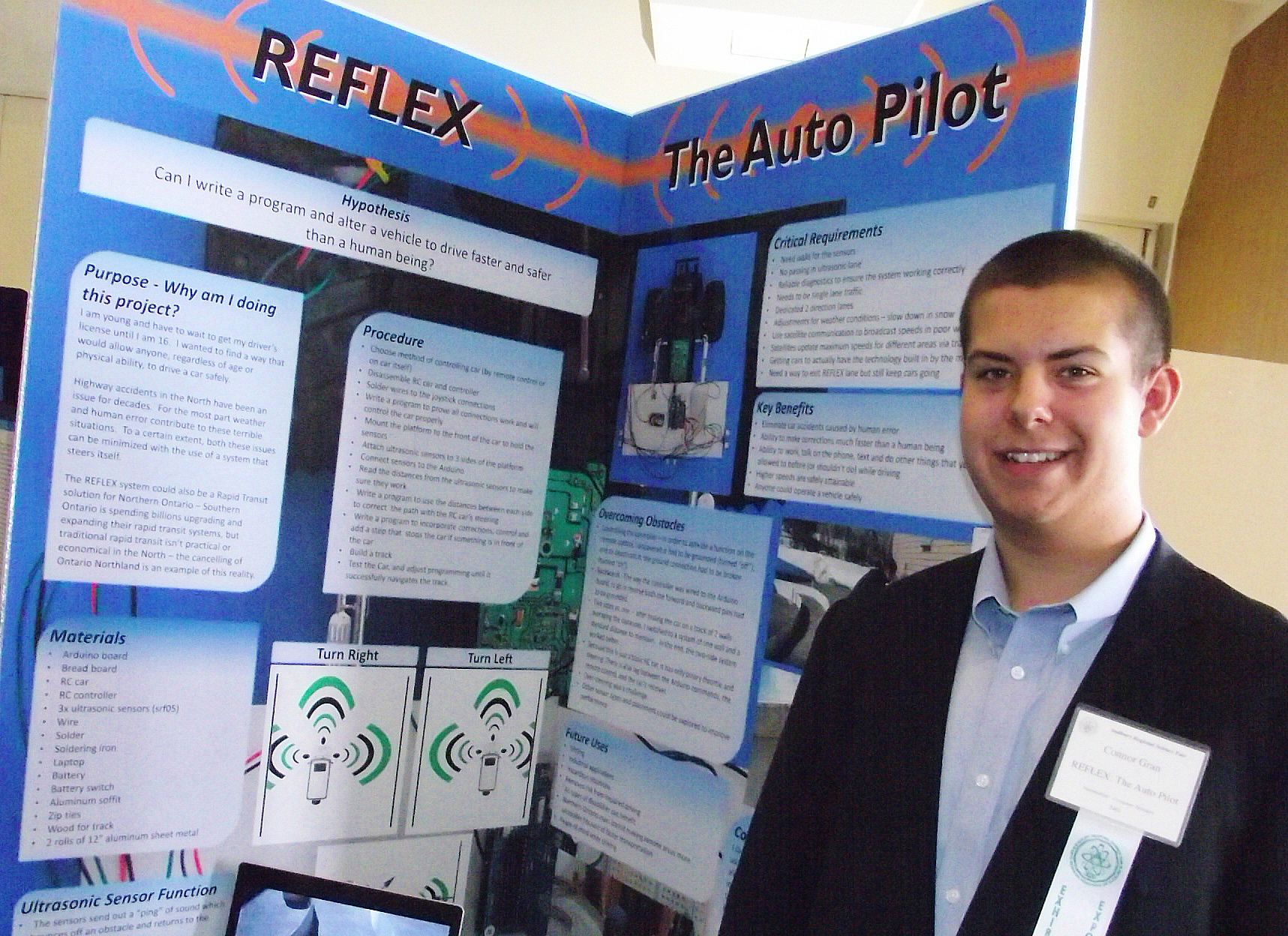 REFLEX: The Auto Pilot
Connor Gran – Grade 10
Lo-Ellen Park Secondary School
Connor Gran programmed a robot to drive a car faster and safer than a human. The system that he developed autonomously controls a remote control car. The Arduino micro-controller and ultrasonic sensors combine to make the car drive between two barriers. The goal of the system is to eliminate the opportunity for human error, improving safety, lessening the risks associated with impaired or distracted driving, and allowing people with disabilities more freedom. Beyond cars, the REFLEX system can be used effectively in any driving situation while reducing the opportunity for human endangerment. This includes all facets of industry, including mining and transportation. Connor Gran believes this system is effectively the embodiment of the self-driving car of the future.
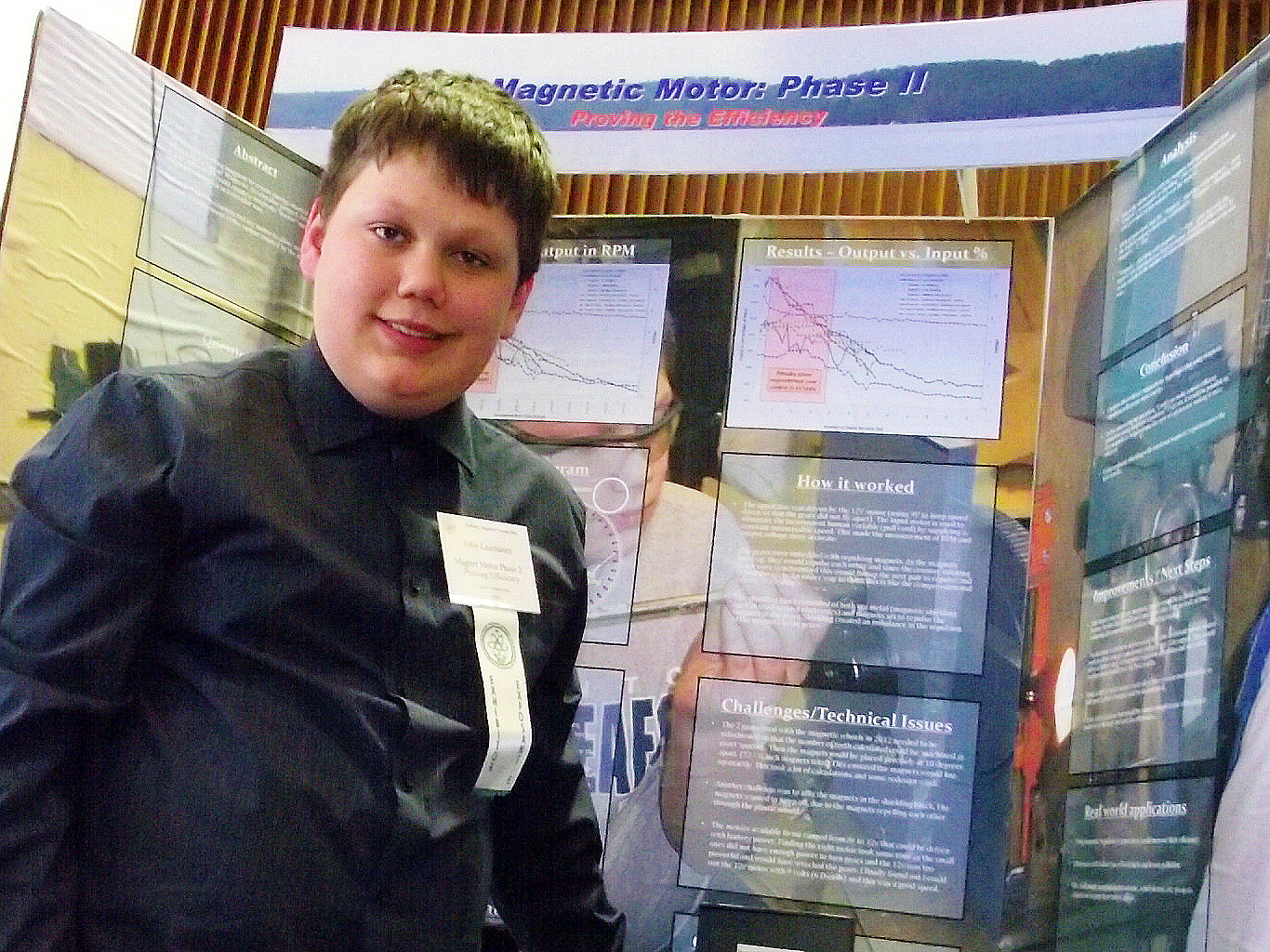 Magnet Motor Phase 2 – Proving Efficiency
John Laamanen – Grade 8
Algonquin Road Public School
John Laamanen, whose project was “Best in the Fair”, is returning to the national level. Last year, he devised an apparatus to test his theory that synchronized rotating wheels embedded with repulsing magnets would be able to produce energy. To prove his theory, he used human input power and measured how long the device would stay running. This year, John replaced the human input with an electric motor and added a generator. He used a tachometer and voltage to measure output. After conducting his research, John determined that the motor he developed using repulsing magnets is more efficient than a regular motor generating energy on its own.
 Using a Gravity Well as a Simulation Part 2: Planets Orbiting a Binary Star System
Connor MacLean – Grade 8
Algonquin Road Public School
Connor MacLean used a homemade gravity well to simulate the conditions under which planets orbit a binary star system. Last year, Connor constructed a large gravity well to examine orbital paths around a single star. This year, the gravity well was uniquely modified so it would contain two smaller gravity wells simulating a binary star system. The idea for this newly designed gravity well came after NASA announced in 2011 that the Kepler space telescope had discovered for the first time a planet orbiting two stars (previously thought to be impossible). This project demonstrated that the orbital path of a ball bearing (used to simulate the circumbinary planet) followed, in general, Kepler’s laws of planetary motion. It was also determined that the simulated circumbinary planet followed an orbit as if it were circling one large star as compared to two smaller ones. Therefore, it appears that in a binary star system it is the sum of the size of the two gravity wells that is important in determining orbital time.
2013 SUDBURY REGIONAL SCIENCE FAIR WINNERS FROM RAINBOW SCHOOLS
JUNIOR DIVISION – COMPUTER SCIENCES
First Place
Of Prime Importance – Testing for Prime and Composite Numbers
Helen Czapor
R. L. Beattie Public School
Third Place
Trashbot 2.0: The End of the Line
Megan Gran
Algonquin Road Public School
INTERMEDIATE DIVISION – COMPUTER SCIENCES
First Place
REFLEX: The Auto Pilot
Connor Gran
Lo-Ellen Park Secondary School
JUNIOR DIVISION – ENGINEERING
First Place
Magnet Motor Phase 2 – Proving Efficiency
John Laamanen
Algonquin Road Public School
Third Place
Life Off Water
Forbes Frick
Noah Topolinski
MacLeod Public School
JUNIOR DIVISION – LIFE SCIENCES
First Place (Tie)
The Scoop On Poop
Caleb Smith
MacLeod Public School
First Place (Tie)
Be a Buddy Not a Bully
Ceilidh Muise-Macdonald
R. L. Beattie Public School
Third Place
Facebook, the effects on self-esteem
Gabriela Dionne-Herz
R. L. Beattie Public School
JUNIOR DIVISION – PHYSICAL SCIENCES
First Place
Using a Gravity Well as a Simulation Part 2: Planets Orbiting a Binary Star System
Connor MacLean
Algonquin Road Public School
Second Place
How Solar Flares Affect Earth’s Magnetic Field
Andrew Dominick
Markstay Public School
Third Place
How Clean Are Your Clothes?
Sienna Lautenschlager
Rya Funk
Alexander Public School
Fourth Place
How Ice Melts
Jake Horgan
MacLeod Public School
SUDBURY REGIONAL SCIENCE FAIR SPECIAL AWARDS
BILL ROMAN AWARD
"Best in fair" as judged by the exhibitors
5 Second Rule, Safe or Sorry
William Irvine
R. L. Beattie Public School
BIOTECHNOLOGY AWARD
The project which best demonstrates the application of knowledge of biological systems to solve a problem, create a product, or provide a service.
The Scoop On Poop
Caleb Smith
MacLeod Public School
CAMBRIAN COLLEGE AWARD
The best junior, intermediate and senior projects that best deal with a topic or process in the fields of mining, civil engineering technology, chemical engineering technology or renewable energy.
A Spill In The Ocean
April Deisinger
Libby Lawson
MacLeod Public School
CENTRE FOR EXCELLENCE IN MINING INNOVATION (CEMI) AWARD
An innovative project that helps illustrate/underscore the importance of mining research & technology development within society and/or the best project that deals with or contributes to the fields of earth sciences, geology and/or engineering.
REFLEX: The Auto Pilot
Connor Gran
Lo-Ellen Park Secondary School
CHEMICAL INSTITUTE OF CANADA AWARD
The best project that deals with a chemical topic or process.
pH Acids & Bases
Dhruv Sharma
Abhinav Chinnasane
Algonquin Road Public School
CHILD HEALTH RESEARCH AWARD
The best project that deals with children’s health or that could have an impact on children’s health.
Does Gender Influence Restraint Regarding Instant Gratification
Morgan Joly
Markstay Public School
DENNIS ROBERTS MEMORIAL AWARD
The project which studies individual or group human behaviour, animal behaviour, or thinking/feeling processes with emphasis on adherence to ethical principles in studies with human or animal subjects.
Patterning and Memorization
Ritik Nangia
MacLeod Public School
FOUNDING MEMBERS’ AWARD
The project which exemplifies effort and perseverance. This award honours the contributions of such founding members as Don Davidson, Ed Higgins and others.
Trashbot 2.0: The End of the Line
Megan Gran
Algonquin Road Public School
JACK CEMING CHEMISTRY AWARD
The project must demonstrate outstanding chemistry.
pH Acids & Bases
Dhruv Sharma
Abhinav Chinnasane
Algonquin Road Public School
PURDUE PHARMA CANADA AWARD
The project in the health sciences area that best demonstrates the application of good scientific method.
Power of a Placebo
Samantha Gibson
Emily Ferguson
R. L. Beattie Public School
SNOLAB AWARD
Outstanding project related to sub-atomic physics, astrophysics or astronomy that demonstrates understanding and contributes to overall awareness of the topic.
Using a Gravity Well as a Simulation Part 2: Planets Orbiting a Binary Star System
Connor MacLean
Algonquin Road Public School
LAURENTIAN UNIVERSITY BIOLOGY AWARD
The two best projects that deal with biology.
The Scoop On Poop
Caleb Smith
MacLeod Public School
LAURENTIAN UNIVERSITY EARTH SCIENCES AWARD
The best project that deals with the earth sciences.
The Scoop On Poop
Caleb Smith
MacLeod Public School
LAURENTIAN UNIVERSITY CHEMISTRY/BIOCHEMISTRY AWARD
The best project that deals with chemistry or biochemistry.
Colour Strength of Natural Dyes
Brynn Kiley
Savanna Webb
Central Manitoulin Public School
LAURENTIAN UNIVERSITY COMPUTER SCIENCE OR MATHEMATICS AWARD
The project that best deals with mathematics or computer science.
Of Prime Importance – Testing for Prime and Composite Numbers
Helen Czapor
R. L. Beattie Public School
LAURENTIAN UNIVERSITY ENGINEERING SCIENCE AWARD
The project that best deals with engineering.
REFLEX: The Auto Pilot
Connor Gran
Lo-Ellen Park Secondary School
Chairlift Safety
Quinn Ross
R. L. Beattie Public School
LAURENTIAN UNIVERSITY FORENSIC SCIENCES AWARD
The project that best deals with forensic science.
How Clean Are Your Clothes?
Sienna Lautenschlager
Rya Funk
Alexander Public School
LAURENTIAN UNIVERSITY NEUROSCIENCE AWARD
The project that best deals with neuroscience.
Patterning and Memorization
Ritik Nangia
MacLeod Public School
ONTARIO POWER GENERATION AWARD
Best application of renewable energy or electrical principles to solve a technical or practical problem in the industrial, commercial or residential fields.
Magnet Motor Phase 2 – Proving Efficiency
John Laamanen
Algonquin Road Public School
Life Off Water
Forbes Frick
Noah Topolinski
MacLeod Public School
MODERN MINING AND TECHNOLOGY SUDBURY AWARD
The best overall project that deals with some aspect of mining.
Trashbot 2.0: The End of the Line
Megan Gran
Algonquin Road Public School
LAURENTIAN UNIVERSITY SCHOLARSHIP AWARD
Magnet Motor Phase 2 – Proving Efficiency
John Laamanen
Algonquin Road Public School
BEST IN FAIR
Magnet Motor Phase 2 – Proving Efficiency
John Laamanen
Algonquin Road Public School
-30-
Media Contact:
Nicole Charette, Senior Advisor,
Corporate Communications and Strategic Planning,
Rainbow District School Board, 705-674-3171, ext. 7217.